Retail software benefits for managing stores
How Retail POS Software Helps Stores Manage Billing, Inventory, and Customers
Operating a retail store comes with hundreds of day-to-day decisions. What products are selling fastest? What should be reordered? Which items need to be disposed of? How much did the store make today? What customers are buying from us? Without integrated billing, inventory, purchasing, and customer management systems, answering such questions can require time-consuming detective work. A point of sale (POS) software can help in this case: A contemporary POS system can consolidate daily sales data with inventory, purchasing, and customer information and thus provide an integrated view of the business.
What Does Retail POS Software Actually Do? A retail point of sale system is certainly not just a billing system. It can be used for multiple daily retail tasks, such as billing/invoicing, product and inventory management, purchase management, customer management, sales management, returns and refunds, barcode-based billing, business reporting, multi-store management. And the primary difference is that these activities are connected together. For instance, you can link a sale to inventory information. You can update inventory when you purchase goods. And you can analyze sales data and profit to identify which products are popular and which are not.
Faster Billing at the Retail Counter Long queues at the billing counter lead to a poor customer experience, especially during peak hours. Weekends, festivals, and holidays are some of the busiest times for any retail store. A retail point of sale system can help shorten the billing time by scanning the products and providing an option to pay and print receipts from a single interface. Reecost’s POS software provides an easy and efficient way to search the product, scan barcodes, apply and remove discounts, pay and print receipts. It supports electronic and printed receipts, discounts, taxes, refunds, connections to barcode scanners, printers, cash drawers, etc. The intent is to streamline the billing process and reduce the time spent entering data manually.
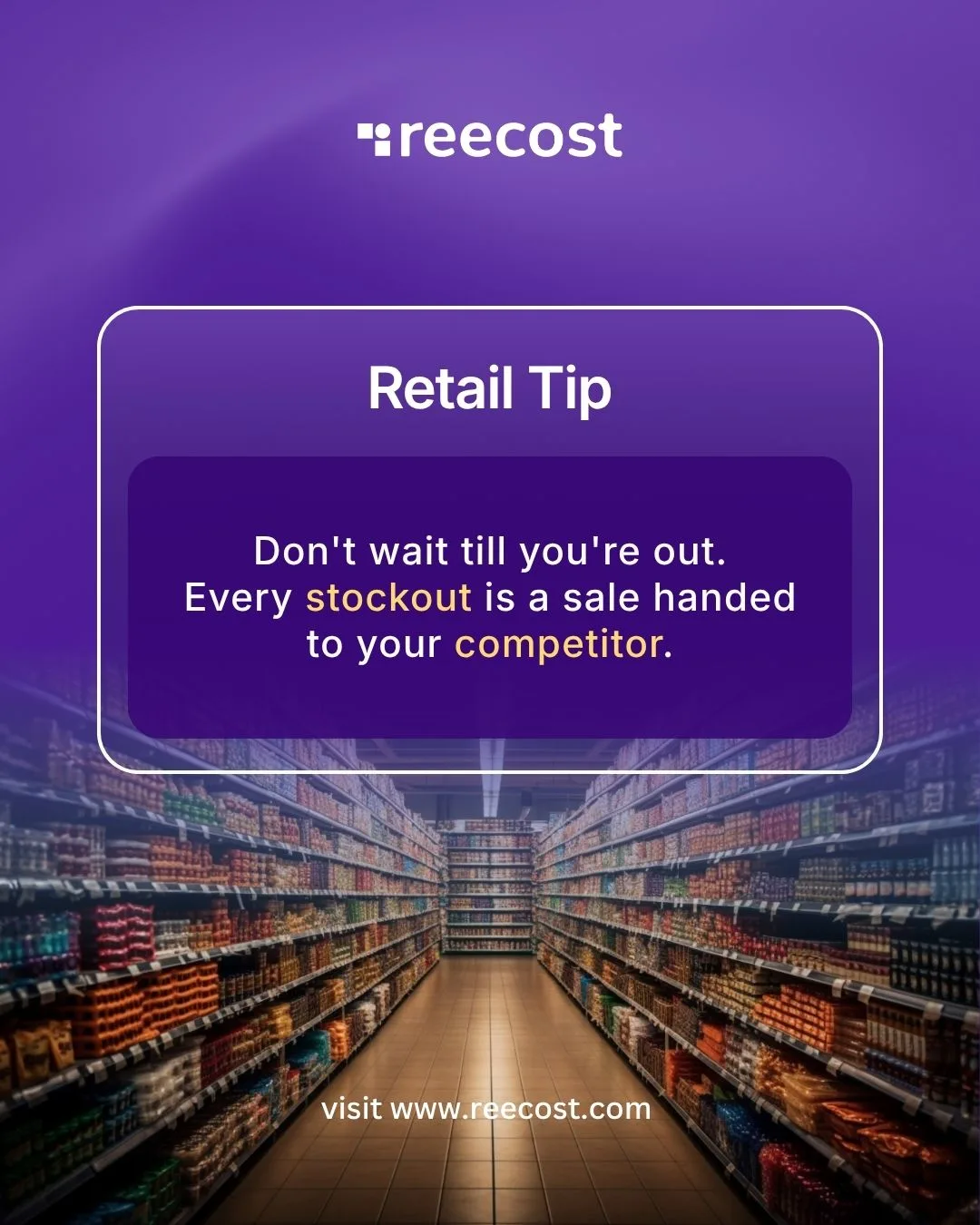
Keep the inventory updated on every sale Inventory remains one of the biggest challenges in the retail business. A retail store loses sales when a popular item is out of stock. Moreover, a retail store can also lose sales when an overstocked product remains unsold. A connection between billing and inventory helps in a better management of stock The software mentions real-time inventory with alerts for low stock, expiry dates, and barcoding for stock audits and reports. This helps in addressing common inventory problems faced by a retail store. It also helps a retail store answer basic questions like: What do we have in stock? What is selling out? What is selling fast? What needs to be managed? Where is it going?
Make Purchasing More Organized Retail inventory does not begin at the cash register. It begins at purchase. In order to be able to effectively manage their inventory, retailers must be able to keep track of their suppliers, purchase orders, incoming stock, and company's purchase history. By connecting POS to purchase management functions, the purchase, as well as the inventory, management becomes seamless. Using Reecost, users can manage their purchase orders, keep track of their suppliers and company's purchase history and update their inventory once the ordered items are received. This way, the need to separately track and record both purchases and inventory is eliminated.
Use Sales Data to Understand Product Performance A daily sales total tells only part of the story. Retail owners may also want to know: Which products are selling fastest? Which categories are bringing in the most sales? What are the busiest selling periods? Which products are not moving? How are sales changing over time? Retail POS software can turn transaction data into reports that are easier to review. Reecost provides real-time reports and dashboards, while its Pro plan currently includes access to 80+ real-time reports. These reports can help store owners make purchasing, pricing, promotion, and inventory decisions based on actual sales activity rather than assumptions.
Build Better Customer Relationships A retail transaction does not have to end with a receipt handover. With the help of customer management features, a retailer can get to know their buying trends and encourage their return to the store. Such features as customer data access, purchase history and preferences, loyalty programs, and targeted messaging can be found in Reecost’s CRM. With them, a business will be able to analyze the information about their clients, such as: Most popular items Repeat customers Their preferences Loyalty program activity Purchase history This way, an organization will be able to get more profit with the help of a single sale and invest more effort in keeping customers rather than one-time monetary benefits.
Why Barcode Billing is Important in Retail Manually entering the information of a product during the billing process can be tedious and error-prone. Barcode scanning can help identify products much faster. A barcode retail POS system can help you scan the product fetch details of the item add it to the bill apply the relevant pricing or discount take the payment and update the relevant sales and inventory records For businesses dealing with hundreds or thousands of SKUs, this can make a world of a difference to their daily operations. Recreating this process manually can be incredibly time-consuming. Reecost also lists barcode generation as a pro.
Manage Multiple Retail Locations Leading one store is undoubtedly different from managing many. As soon as the need emerges to oversee several retail units at once, owners have to find a way to compare sales, inventory, and other metrics across locations. Using a multi-unit point of sale solution streamlines the process considerably, as it eliminates the need to view every single location on a separate screen or software interface. Reecost’s Pro plan offers multi-location management, but the company’s overall system is intended to consolidate this data into a single source for easier review and analysis. This feature is especially valuable for retailers that foresee expansion as an imminent possibility.
Cloud Access Provides Greater Flexibility for Retail Owners Retail owners are not always at the billing counter. They can be at the warehouse, purchasing new goods, checking with suppliers, working at another store, or doing other activities. A cloud-based point of sale can provide greater flexibility by making the data available to different computers. Reecost highlights that its software can be accessed through the cloud to offer billing information, inventory, purchasing options, and customer data. It means that a retail owner can check the records from different devices, including a computer or a phone, convenient for accessing and following-up on daily transactions.
What should Retailers look for in a POS system? Many retail businesses’ needs will differ; however, there are several vital components of a retail POS system that should be considered. Billing and Payments The software should make day-to-day billing processes simple and accommodate the different payment methods that customers might want to use. Inventory Management The software should allow the user to monitor inventory in real-time and provide low-stock warnings, inventory adjustment tools, warehouse stock management, and inventory reports. Purchase Management The purchase module should be integrated with inventory management, have supplier information, purchase order management, and purchase history. Customer Management Should have customer profiles, purchase history, loyalty programs, and other useful tools to build a customer base that will provide long-term value to the business. Reports The program should offer sales reports, inventory reports, purchase reports, and other essential documents that can be used for managerial purposes. Multi-Location Management This feature allows users to oversee all of their retail stores in one place. It is a must-have for large-scale or multi-store businesses. User-Friendly Interface Finally, it is critical to choose the retail point of sale software that has an intuitive interface so that employees can get up to speed quickly and work efficiently without undergoing an unfriendly learning curve.
Reecost for Retail Businesses Reecost consolidates multiple retail operations in one cloud platform including billing in POS, inventory, purchase management, customer management and reports. Designed with the philosophy that retailers should not have to juggle different software for different needs For a small retail store this means getting rid of manual billing and excel sheets while for a growing retail business it means having greater control on inventory, purchase, customers and sales.
Final Thoughts Retail POS software is most useful when it is utilized for more than just generating invoices. A good point-of-sale system will allow billing, inventory, purchasing, and customer management, along with reporting, to come together and give the retailer an in-depth view of the business. As opposed to asking generic questions, such as how much was sold on a given day, it will enable the store owner to ask better questions about what, why, and how sales occur. It will empower them to determine what products need reordering, what customers are returning, where the profits are, and where sales opportunities might be missed. This is the point at which a modern retail POS system stops being simply a billing tool and becomes a powerful managerial tool.